
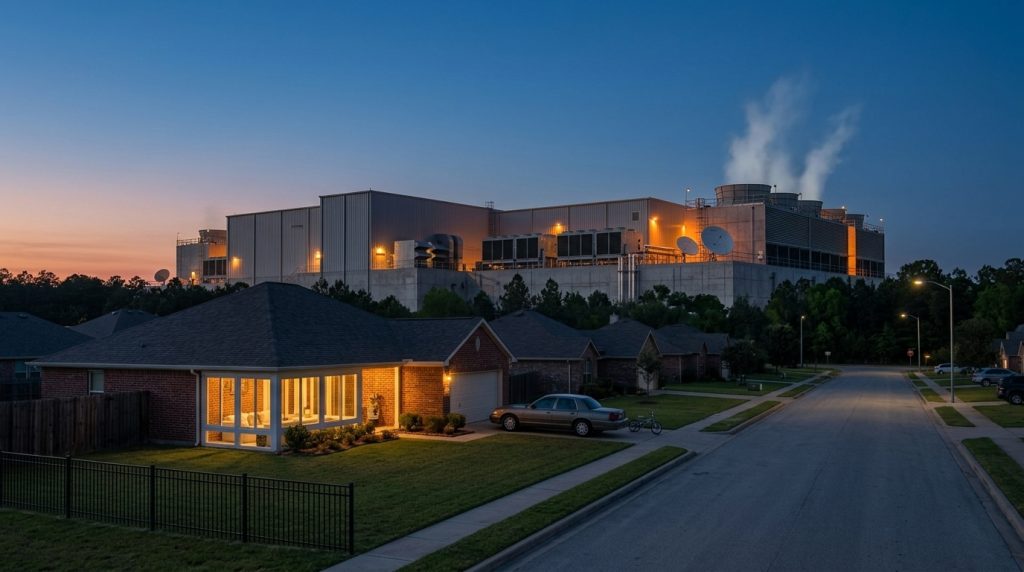
The Hum That Moved In With You
It started maybe a year ago. Or two. You weren’t sure at first what it was. A low, constant sound. Almost more of a feeling than a noise. It’s there when you wake up and there when you go to sleep. Your neighbors hear it too. Someone eventually figures out it’s coming from the new data center facility that went up a half-mile away.
This is happening in neighborhoods across Texas right now. The data center industry is expanding at a pace that’s hard to overstate. According to CBRE Research, the United States added over 5,000 megawatts of new data center capacity in 2024 alone, with Texas representing one of the fastest-growing markets in the country.
These facilities require enormous amounts of cooling. That means rows of industrial HVAC units, cooling towers, and backup generators running around the clock. The acoustic output is significant. And unlike traffic noise, which has rhythm and variation, data center noise is constant. Flat. Unrelenting.
For residents who live within a half-mile of one of these facilities, it changes the character of their home in a very specific way.
Why This Kind of Noise Is Particularly Hard to Ignore
There’s research behind why constant low-frequency noise is more psychologically taxing than intermittent louder sounds. The World Health Organization has published guidance on environmental noise and health, finding that chronic exposure to low-level noise, particularly during nighttime hours, is associated with sleep disturbance, cardiovascular stress, and reduced cognitive performance.
Data center noise typically sits in the 50 to 70 decibel range at the fence line, dropping to 40 to 60 decibels at a residential distance of a few hundred meters. That’s not loud enough to cause hearing damage. But it’s loud enough to prevent the brain from fully settling into rest.
Low-frequency sound is also harder to block than high-frequency sound. A standard window that filters out street-level conversation does relatively little to attenuate the 100 to 200 Hz range where HVAC hum lives. This is the core acoustic challenge for residents near these facilities.
What Standard Windows Can’t Do
I talk to homeowners all the time who have tried various fixes. Heavier curtains. White noise machines. Replacing weatherstripping. Some have even gotten quotes for new windows, hoping the replacement glass would solve the problem.
Most of them come away disappointed.
Here’s why: standard double-pane replacement windows improve thermal performance and reduce mid-to-high frequency noise meaningfully. But for low-frequency sound in the 100 to 300 Hz range, the acoustic improvement is modest at best. The air gap between the panes is too small to create effective resonance damping at those wavelengths.
The physics of sound blocking at low frequencies requires either significant mass (thick glass or concrete) or a large air gap. Standard replacement windows provide neither in sufficient quantity to address a data center’s dominant frequency output.
How Interior Window Insulation Panels Change the Equation
Our interior window insulation panels create something standard windows can’t: a large, sealed dead-air space between the existing window and the new interior panel.
That air gap is typically 2 to 4 inches deep, depending on the window frame depth. At low frequencies, that gap acts as a resonance chamber that dissipates acoustic energy before it reaches the interior of the room. Combined with the perimeter seal that our panels form against the window frame, the result is a substantial improvement in low-frequency sound attenuation.
It’s not magic. And I’ll always be honest: no interior solution eliminates a nearby industrial noise source entirely. But the difference between sleeping with the hum coming through clearly and sleeping with it reduced to background ambience is enormous for quality of life.
Residents in La Porte and Deer Park, two areas in Harris County that are seeing significant industrial expansion, have been using our noise reduction window inserts for exactly this reason. The results are consistent. The hum drops to a level most people describe as manageable or barely noticeable.
What to Realistically Expect
Before someone calls us with a data center noise problem, I want to set honest expectations.
If the facility is directly adjacent to your property, within 200 feet or so, no window treatment will fully eliminate the noise. At that distance, sound is entering through the walls and roof as much as the windows, and a window-only solution can only do so much.
At distances of 500 feet or more, which covers most residential situations near these facilities, our panels make a significant and clearly perceptible difference. That’s based on what we’ve seen in real installations, not a marketing claim.
We also customize based on your specific window type and frame depth. Homes with deeper window frames can accommodate a wider air gap, which improves low-frequency performance. Homes with shallower frames still benefit from the perimeter seal and the second acoustic barrier, just with a slightly smaller air column.
Every situation is a little different. That’s why we start with a real conversation about what you’re experiencing before we spec anything.
The Bigger Picture: Texas Is Building Fast
Data centers aren’t going away. If anything, the AI computing boom is accelerating facility construction in Texas faster than in almost any other state. The power grid availability, favorable land costs, and business-friendly permitting in Texas make it a prime target for hyperscale data center investment.
That means more neighborhoods in the Houston metro, in the Katy corridor, out toward Waller, and in suburban Harris County generally will face this same noise issue in the coming years. Residents who act now with interior insulation panels are building in a buffer that also improves their home’s thermal performance, reducing energy bills at the same time they’re solving the noise problem.
Two problems, one installation, no demolition.
If you’ve been dealing with constant mechanical noise from a nearby facility and you’re not sure what can actually be done, reach out to us through our contact page. We’ve been doing this for over 40 years, and we’ll give you a straight answer about what our panels can do for your specific situation. No pressure. Just honest information.