
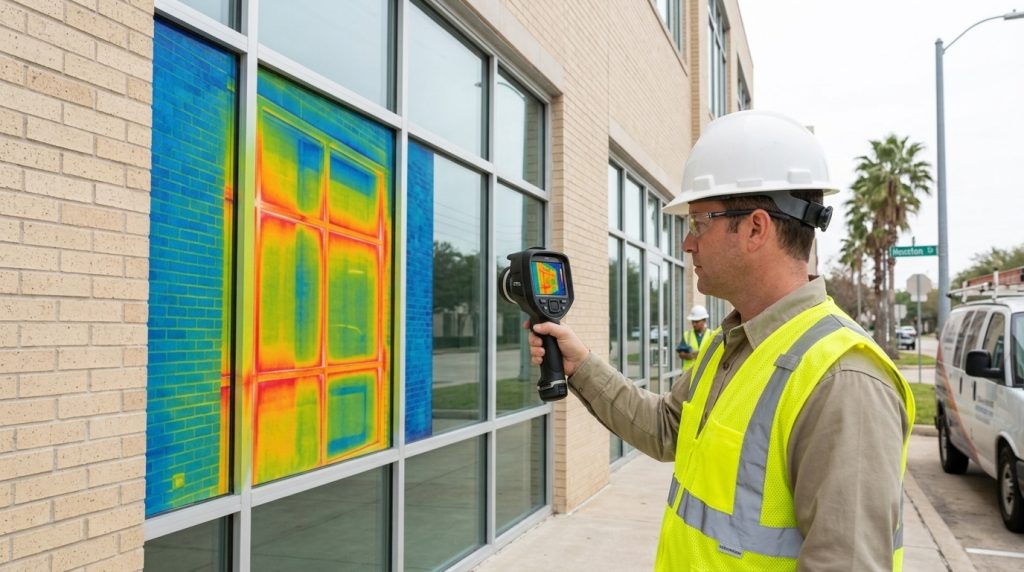
The Energy Audit Result Nobody Wants
You commissioned the audit because you had to, or because energy costs had gotten high enough that you needed data. The results came back and the windows are flagged. Significant thermal loss. Poor thermal envelope performance. Recommendations to upgrade or replace.
And now you’re staring at a remediation plan that reads like a construction project.
This is a situation we encounter regularly with commercial property owners and managers across the Houston area. The audit is correct. The windows are underperforming. But the assumption that remediation means full window replacement is wrong, and it’s costing building owners serious money by steering them toward the most disruptive and expensive option when a better one exists.
Interior window insulation panels are one of the most underutilized tools in commercial energy audit remediation. Here’s why they should be part of every property manager’s conversation with their energy consultant.
What an Energy Audit Is Actually Measuring
Let’s make sure we’re speaking the same language. A commercial energy audit evaluates how efficiently a building uses energy, typically identifying where energy is being lost and ranking improvements by cost and impact. Windows almost always appear on that list, and for good reason.
Single-pane windows have an R-value of roughly 1. Standard double-pane runs R-2 to R-3. An insulated wall section runs R-13 or higher. By comparison, windows are the weakest link in almost every commercial building envelope built before the 2000s.
ASHRAE Standard 90.1, the primary energy standard for commercial buildings in the United States, provides the performance benchmarks that auditors use to evaluate window and envelope performance. When your windows fall significantly below those benchmarks, the audit flags them.
But the standard doesn’t dictate HOW you improve performance. It specifies the outcome. That distinction is important, because it opens the door to interior panel solutions that achieve the required performance improvement without the cost and disruption of replacement.
Why Interior Panels Are a Legitimate Remediation Tool
Skepticism is fair here. Property managers and building owners often assume that a secondary glazing solution won’t satisfy an auditor the same way that documented replacement windows would. In practice, that’s not accurate.
What auditors care about is measurable improvement in the building’s thermal envelope. Interior window insulation panels, properly specified and installed, can push the effective R-value of an existing single-pane window from R-1 to R-4 or higher. A single-pane window with a quality interior panel can actually outperform a standard double-pane replacement window on thermal metrics.
That performance can be documented. The air gap dimension, the panel material specifications, and the edge seal quality are measurable parameters. A building owner can present that data to an energy auditor as part of a remediation report, and in most cases it satisfies the audit’s requirements without a single pane of glass being removed.
We’ve spent 40 years building and refining this technology. The NASA performance validation study cited on our homepage isn’t a marketing decoration. It’s the kind of third-party performance documentation that holds up in professional contexts, including energy audit remediation conversations.
The Cost Comparison Is Not Close
Commercial window replacement at scale is expensive in a way that deserves to be stated plainly. A mid-rise office building with 200 windows could easily face a replacement bill of $400,000 to $800,000 or more, depending on window size, type, and access requirements. Add in the operational disruption, the tenant notifications, the potential temporary loss of leasable space, and the project management overhead.
That’s before you factor in the timeline. A full commercial window replacement program for a large building can take months.
Interior window insulation panels can be installed on a floor-by-floor or zone-by-zone basis with no tenant displacement required. Installations happen on the interior, during normal business hours, with minimal disruption to building operations. For a building owner who needs to demonstrate remediation progress to a lender, insurer, or municipal energy compliance program, a phased interior panel installation is a realistic path.
For reference, the Energy Information Administration’s Commercial Buildings Energy Consumption Survey documents that windows and the building envelope account for a significant share of commercial energy waste nationally. The remediation opportunity is real. The method doesn’t have to be the most expensive one.
Historic Commercial Buildings Are a Special Case Worth Mentioning
Some commercial buildings in Houston, particularly those in downtown, Midtown, or the Heights, carry historic designation or are part of preservation districts. For these properties, window replacement may not even be an option.
The Secretary of the Interior’s Standards for Rehabilitation, the governing framework for historic preservation work, generally permit interior secondary glazing as an acceptable energy improvement because it does not alter the historic window fabric visible from the exterior. This makes interior panels not just the preferred solution but often the only compliant one for landmarked commercial buildings.
We’ve done this work before. Our historic window preservation approach is designed specifically for situations where the windows themselves have protected status. The performance improvement is real and the historic character of the building stays intact.
How to Move Forward After a Failed Audit
The path from a failed energy audit to a completed remediation doesn’t have to be a multi-year construction ordeal. Here’s how we typically approach it with commercial clients.
First, we do a window inventory. We identify which windows are flagging the worst performance, typically by orientation and window type. South- and west-facing windows in Texas absorb the most solar heat gain and are usually the highest priority.
Next, we specify the interior panel system for each window type. Not every window in a building is the same, and a proper specification accounts for window size, frame condition, and the performance target needed to satisfy the audit.
Then we schedule installation in phases that work around the building’s operations. For occupied office buildings, installations happen unit by unit or floor by floor. For retail or hospitality properties, we schedule around peak hours.
The documentation package we provide at project completion is designed to support your remediation reporting. Performance specifications, installation records, and product data sheets.
If your commercial property in Houston, Katy, La Porte, Deer Park, or anywhere in Harris County has come out of an energy audit with windows flagged as a problem, let’s talk. Visit our commercial window solutions page or contact us directly. We’ll tell you plainly what interior panels can achieve for your building and whether they’re the right path for your audit remediation.